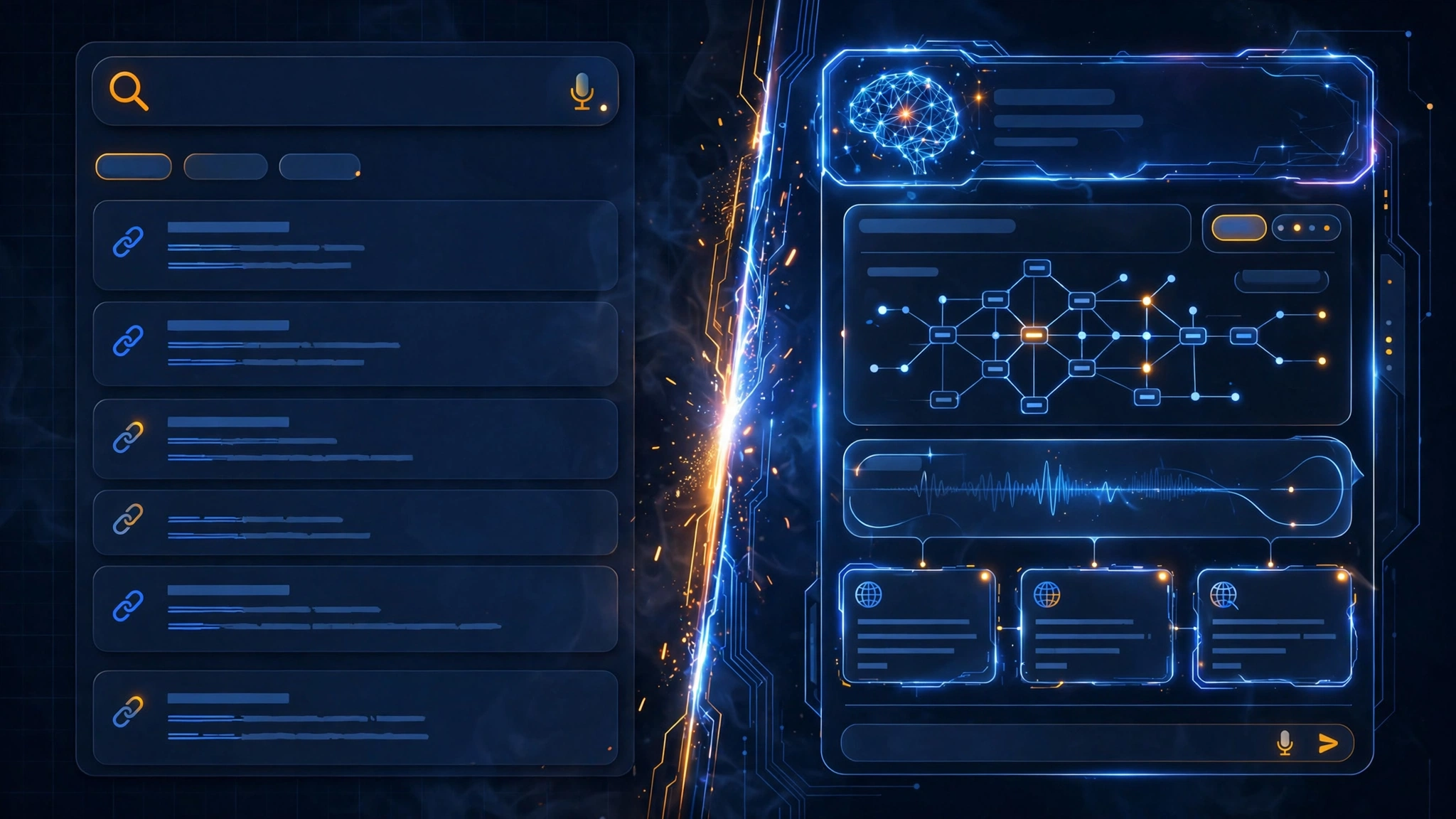
For twenty years, the rules of being found online were stable: build a website, optimize it for Google, climb the rankings, get found. An entire industry, SEO, grew up around those rules, and most businesses learned at least the basics.
Those rules are now being rewritten in real time, and most businesses have not noticed yet.
The change isn’t a new Google algorithm update. It’s more fundamental: people are starting their searches inside AI systems instead of search engines. They ask ChatGPT for recommendations, ask Perplexity to compare options, read the AI-generated answer at the top of Google instead of scrolling the blue links. And those AI answers work differently. They don’t show ten links and let you choose. They read the web, synthesize an answer, and mention a handful of businesses by name. Everyone else is invisible.
This is the single biggest shift in business visibility since Google launched, and it rewards a completely different set of behaviors than classic SEO.
The Old Game: Rankings
In traditional search, Google showed a ranked list of links, and your job was to get as high as possible. Rank on page one, position three, for “best plumber in Roswell GA,” and you got a predictable share of clicks. The system was transparent in a rough sense: everyone could see the rankings, everyone roughly knew what drove them (relevance, authority, backlinks, content quality), and results were stable enough to build a business around.
The key property: visibility was ranked and browseable. Ten results on page one, a hundred on page ten. Even at position eight, a motivated searcher could find you. Visibility was a spectrum, and almost everyone on it got some traffic.
The New Game: Mentions
AI answer engines do not show a ranked list. They produce an answer.
Ask Perplexity “who is the best plumber in Roswell GA” and the system retrieves information from across the web, synthesizes it, and writes a response naming maybe three to five businesses. Those get mentioned. The rest don’t appear at all. No page two. No position eight for a persistent searcher to scroll to. You’re either in the answer or you’re not.
This is the core of the shift: visibility moved from rankings to mentions.
It sounds subtle. It isn’t. Consider a local business that spent five years building solid SEO: ranking well in Google, fast website, good content, strong reviews. Under the old rules, they’re winning. But when a customer asks ChatGPT for a recommendation, the system might not mention them at all, because the criteria for being mentioned in a synthesized answer differ from the criteria for ranking in a list of links. A business can do everything right by the old rules and still be invisible in the new environment.
Not hypothetical. Already happening. (BrightEdge research found click-through rates dropped nearly 30% after AI Overviews launched – see The Letter Two’s coverage; Ahrefs later measured a 58% lower click-through rate for top-ranking pages when an AI Overview appears)
How People Actually Search Now
The old pattern: type a short query into Google, scan the results, click a link, read a page, maybe go back and click another. The searcher did the synthesizing, comparing options themselves.
The new pattern: ask a full question in natural language, read the synthesized answer, act on it. The AI does the synthesizing. The searcher trusts the answer and often never clicks through at all. These “zero-click” interactions are growing fast. (SparkToro’s 2026 analysis found 68% of US Google searches ended with no click, up from 60% in 2024 – see The Blog Herald’s summary; Pew Research separately found searches showing an AI summary produced a click only 8% of the time, versus 15% without)
Think about the last time you used an AI assistant to research something: restaurant recommendations, a product comparison, a service provider. Did you click through to five websites and compare them yourself? Or read the answer, pick a mentioned option, and move on? Most people do the latter. That behavior is the whole ballgame.
For businesses, the implication is direct: the moment of decision is moving inside the AI answer, upstream of the website visit. If your business isn’t mentioned, you never get to make your case. Beautiful website, compelling copy, online booking system: none of it matters if the customer never arrives.
Why Rankings Do Not Guarantee Mentions
This surprises people, so let me be precise.
Ranking well in Google and being mentioned by an AI engine are related but distinct achievements. They overlap (both value authoritative, relevant content) but diverge in important ways:
AI engines synthesize; search engines list. Google’s job was pointing you to the best pages. An AI engine’s job is answering your question directly, which needs content it can extract clear, confident statements from, not just topically relevant pages.
AI engines cite differently. When Perplexity or Google’s AI Overviews mention a business, they cite the specific sources that informed the answer. Citation research shows AI systems favor sources that are clear, structured, and directly answer the question asked: not always the pages that rank highest. (the Princeton GEO study (Aggarwal et al., KDD 2024) found that clear, fluent prose was the single highest-impact factor for AI citation visibility – see the paper)
AI engines weigh different trust signals. Traditional SEO leans on backlinks and domain authority. AI systems consider those too, but additionally weigh clarity of information, consistency across sources, and how explicitly a page states the facts the system needs. A page clearly saying “we are a family dental practice in East Cobb specializing in pediatric dentistry” may beat a higher-ranking page with vaguer copy.
AI engines are probabilistic. Ask the same question twice and you may get different answers with different businesses mentioned. Unlike traditional rankings, relatively stable day to day, visibility in AI search isn’t a position you hold; it’s a probability you influence. Big implications for measurement, which we’ll cover in a later article.
The practical takeaway: your Google rankings are still valuable but no longer sufficient. They measure visibility in one system. A growing share of customer discovery now happens in a different system with different rules.
How Fast Is This Happening?
Is this a future problem or a current one? Already current, and accelerating.
The major platforms have all moved decisively: Google integrated AI-generated answers into search results; ChatGPT added web search, turning a conversational assistant into a discovery tool; Perplexity built its product around answered questions with citations. Not experiments or betas. Shipping products with large, growing user bases.
User behavior is following. People who try asking an AI assistant for a recommendation tend to keep doing it: faster, often better than the old scan-and-click routine. Each person who switches is one fewer browsing the traditional results page where your rankings live. The shift doesn’t need everyone to change at once. It needs a growing minority to change their default behavior, and that’s exactly what’s happening.
For businesses, the timing math is simple: adapting early costs little (clarity, structure, consistency); adapting late costs a lot (catch-up against competitors who moved first). No penalty for starting now. Real penalty for waiting until the shift is obvious to everyone: by then, early movers have already established citation patterns in their favor.
(Stan Ventures’ July 2026 State of Perplexity report puts Perplexity at an estimated 1.2-1.5 billion monthly queries and ~45 million monthly active users – see the report)
What This Means for Your Business
First, audit your assumptions. If your marketing plan says “we rank well, so we’re visible,” that assumption needs updating. Ranking well is necessary but not sufficient. You need to know whether AI systems mention your business when customers ask relevant questions. (We’ll show you how to check in an upcoming guide.)
Second, clarity beats cleverness. AI systems need to understand what your business is, what it offers, who it serves. Vague marketing copy humans can puzzle through (“we deliver innovative solutions for dynamic enterprises”) is nearly useless to a machine deciding whether to mention you. Explicit, specific, structured information wins: name your services, state your location, say who you serve. Sounds obvious, but a remarkable number of business websites fail at it.
Third, consistency matters more than ever. AI systems build confidence by corroborating information across sources. If your website says one thing, your Google Business Profile another, and a directory listing a third, the system trusts none of it fully. Aligned, consistent information across the web makes you easier to mention with confidence.
Fourth, this is early. Businesses that adapt now, while most competitors are unaware, get a genuine first-mover advantage. AI search behavior is still forming; citation patterns are still stabilizing. Establish a clear, structured, authoritative presence now and you’re positioned as the landscape matures, not scrambling to catch up later.
The Bigger Picture
Every major change in how people find information creates winners and losers. The Yellow Pages gave way to Google: businesses that adapted to websites and SEO thrived, those that clung to print ads faded. Mobile search rewarded mobile-friendly sites and strong local listings. Each transition felt gradual until it suddenly wasn’t.
AI search is the next transition. The search box is becoming a conversation. The results page is becoming an answer. And the businesses that will be visible in this new world are the ones that make themselves easy for machines to understand, trust, and mention.
The good news: unlike early SEO, which rewarded technical trickery, the AI search era rewards something more wholesome. Clarity. Honesty. Structure. Consistency. Being genuinely clear about who you are and what you offer. Any good business can do these things.
Over the coming weeks, this publication walks through the full picture: how AI engines decide what to cite, what makes content AI-citable, how to audit your own visibility, and how to build a durable presence in the answer-engine era. For those guides as they publish, the newsletter below is the best way to get them.
Get the AI search briefing
One email a week on how AI search is changing business visibility. No fluff, just what matters.