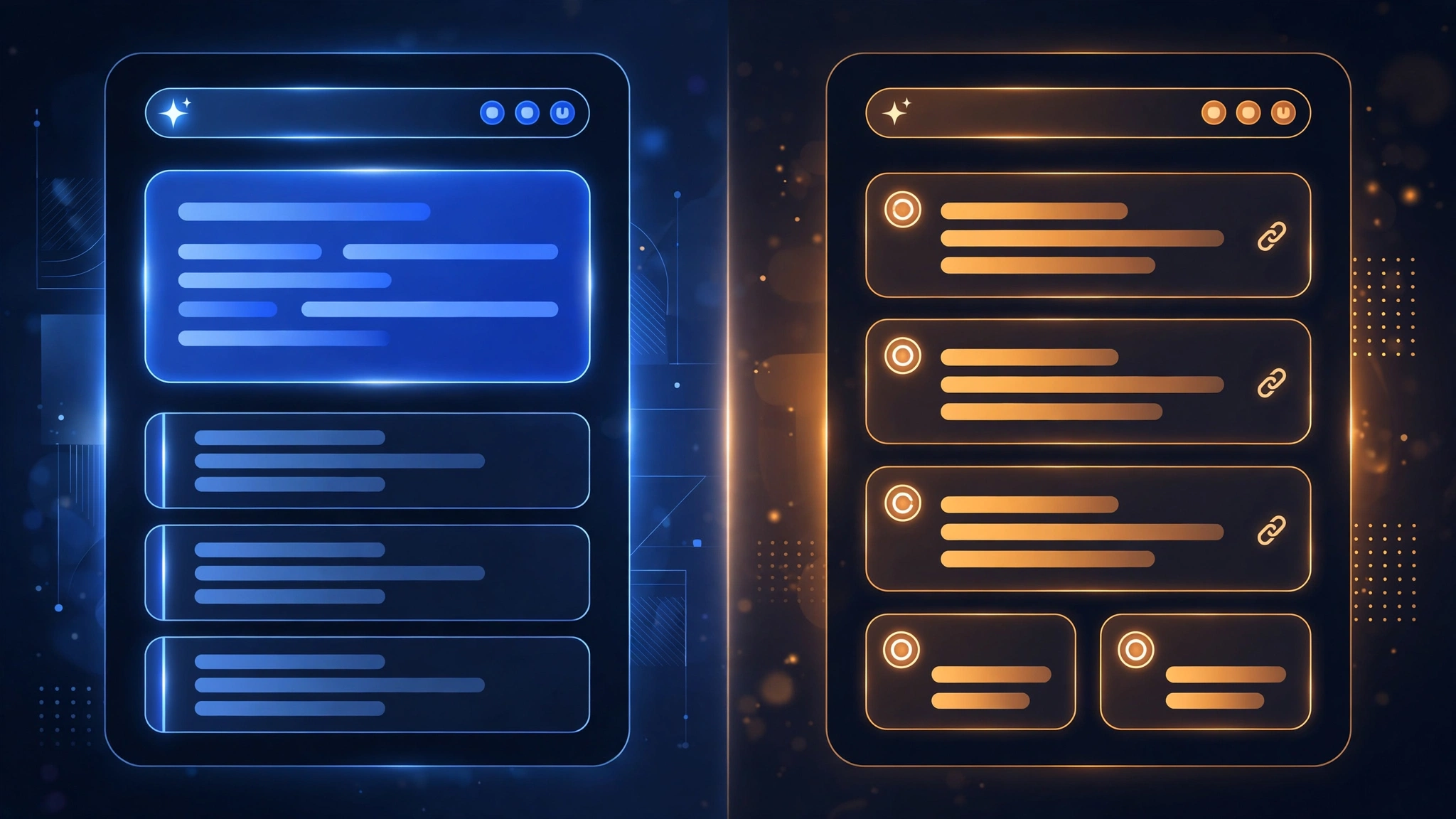
If you’re taking AI search visibility seriously, you’ll hit a question fast: optimize for Google’s AI Overviews, Perplexity, or ChatGPT? Same thing with different logos, or genuinely different systems?
Genuinely different. They retrieve differently, cite differently, reach different users at different moments, and reward somewhat different content properties. Treating them as one thing is a mistake; understanding the differences lets you allocate effort instead of guessing.
This article compares the two most visible AI answer surfaces, Google AI Overviews and Perplexity, from a business visibility perspective: how they work, how they differ, and what each means for your strategy.
The Two Platforms, Briefly
Google AI Overviews are AI-generated summaries at the top of Google search results for many queries. Launched broadly in the US in May 2024, they’re Google grafting generative AI onto traditional search: you search as always, and for many queries an AI-composed answer appears above the classic blue links, with linked sources.
Perplexity is a standalone AI answer engine. You go to Perplexity (or its app) and ask questions conversationally; every answer is synthesized from cited web sources, prominently displayed and linked. It was built from the ground up as an answer engine, not retrofitted onto a search engine.
The distinction, retrofitted vs. purpose-built, shapes nearly every difference that follows.
How They Differ
Reach and context
AI Overviews appear inside Google, intercepting the enormous existing flow of Google searches. A user with no opinion about AI search, who just Googles something the way they always have, may now see an AI-generated answer instead of (or above) the link list. The audience is everyone who uses Google: nearly everyone. The context is traditional search behavior, quick queries, often commercial or navigational.
Perplexity is a destination. Users go there deliberately, usually for research-heavy or complex questions. The audience is smaller but more engaged: professionals, researchers, and early adopters who want sourced, in-depth answers. The context is investigation, not quick lookup.
Business implication: AI Overviews own the broad, high-volume discovery layer: the queries where you used to win clicks from Google’s results page. Perplexity owns the deep-research layer, where high-intent prospects compare options before deciding. Both matter, at different stages of the customer journey.
Citation behavior
AI Overviews link to source pages, but the citations are relatively understated: the answer dominates visually, the sources are present but secondary. Many users read the Overview and never click through. Google also tends to cite a narrower set of sources, often favoring established, high-authority domains.
Perplexity makes citations central: every substantive claim carries a numbered marker, the sources panel is prominent, clicking through is natural. It also cites a more diverse range of sources, including smaller and more specialized sites, as we detailed in our breakdown of how Perplexity chooses sources.
Business implication: An AI Overview citation puts your brand before massive audiences with limited click-through; the value is primarily the mention itself. A Perplexity citation reaches fewer people but with higher engagement and a real chance of the click. Both count, but they convert differently.
Retrieval and ranking logic
AI Overviews are built on Google’s existing search infrastructure. The retrieval layer is, in essence, Google Search: traditional ranking signals (authority, backlinks, relevance) heavily influence which pages the Overview draws from. Rank well in classic Google and you have a head start on AI Overviews, though it’s not guaranteed.
Perplexity runs its own retrieval stack, built for answer synthesis rather than page ranking. It’s less bound to traditional authority signals and more willing to surface specialized or recent sources, which is why the correlation between “ranks #1 in Google” and “cited by Perplexity” is imperfect.
Business implication: Your SEO investment transfers more directly to AI Overviews than to Perplexity. For Perplexity, the properties we covered (direct answerability, structure, recency, specificity) carry more independent weight. A dual strategy covers both: strong SEO fundamentals feed AI Overviews; citability optimization feeds Perplexity and other answer engines.
Query types
AI Overviews appear for a wide range of queries: simple informational ones (“what is X”), how-tos, product questions, increasingly local and commercial queries. Google decides per query whether an overview is warranted, and the breadth is enormous because it rides on all of Google’s query volume.
Perplexity queries run longer, more complex, more research-oriented: multi-part questions, comparisons, “explain like I’m five but also give me the technical version.” An audience doing homework, not just looking something up.
Business implication: If your customers ask simple questions (“plumber near me,” “what does X cost”), AI Overviews are the more relevant surface. Complex ones (“compare these three approaches to Y for a company our size”) point to Perplexity. Most businesses will eventually need both, but the starting priority depends on how your customers actually inquire.
Volatility
Both systems are probabilistic, but their stability differs in practice.
AI Overviews inherit some of Google’s traditional ranking stability: the underlying retrieval is the mature Google index, so the source pool doesn’t swing wildly day to day. The generated text varies; the cited sources stay relatively consistent.
Perplexity’s answers vary more noticeably between runs, reflecting its more dynamic retrieval and willingness to pull from diverse sources. The same question asked twice may cite different pages.
Business implication: Visibility in AI Overviews, once earned, tends to be more durable. Perplexity visibility needs more ongoing attention to recency and freshness. Neither is “set and forget,” but the maintenance cadence differs.
The Comparison at a Glance
| Dimension | Google AI Overviews | Perplexity |
|—|—|—|
| Where users meet it | Inside Google search results | Standalone app/site |
| Audience | Everyone (massive reach) | Researchers, professionals (engaged niche) |
| Query style | Short, traditional search queries | Long, conversational, complex |
| Citation prominence | Present but understated | Central to the experience |
| Source diversity | Narrower, authority-leaning | Broader, recency-leaning |
| SEO transfer | High (built on Google retrieval) | Moderate (own retrieval stack) |
| Answer stability | Relatively stable sources | More variable run to run |
| Primary visibility value | Brand mention at scale | Mention + click-through from researchers |
What About ChatGPT?
The third major surface behaves differently from both.
ChatGPT with web browsing is a hybrid: like Perplexity, it synthesizes answers conversationally; like Google, it operates at massive scale. Its citation behavior has evolved. It now frequently includes linked sources, though historically it was less citation-transparent than Perplexity.
For businesses, ChatGPT matters enormously because of reach: it’s many people’s first and primary AI assistant. When those users ask for recommendations, the same dynamics described here decide who gets named: clarity, structure, corroboration, authority.
The strategic layers below apply to ChatGPT as well. Strong foundations serve all three surfaces; platform-specific differences are real but secondary to the shared fundamentals. We’ll cover ChatGPT’s specific behaviors in a dedicated article.
What This Means for Your Strategy
The central strategic point: don’t assume one optimization path fits every AI surface. But don’t panic about needing five different strategies either. The practical approach is layered:
Layer 1: Foundations that serve everywhere. Clear business identity, structured factual content, consistent profiles across the web, genuine authority signals (reviews, real backlinks, expertise). These feed every AI system. If you do nothing else, do this.
Layer 2: SEO strength for Google surfaces. Continued investment in traditional SEO, quality content, technical health, authority building, transfers most directly to AI Overviews. Your SEO work isn’t wasted in the AI era; it’s the foundation of your Google-surface visibility.
Layer 3: Citability for answer engines. Direct answerability, explicit structure, FAQ content, recency, specificity. These disproportionately help with Perplexity, ChatGPT, and other synthesis-first systems: the newer discipline, and where most businesses have the most ground to gain.
Layer 1 is shared. Platform differences matter at the margins and for prioritization, but the core work, being clear, structured, consistent, and genuinely informative, is universal. Nail the foundations and you’ll be reasonably visible across surfaces; platform-specific tuning is optimization, not rescue.
Looking Ahead
The platform landscape will keep shifting: Google keeps expanding and evolving AI Overviews (including the newer AI Mode experience), Perplexity keeps growing and adding capabilities, ChatGPT’s search features reach yet another audience, and new entrants will appear.
The right posture isn’t chasing each platform’s quirks; it’s understanding the category. Every answer engine must solve the same fundamental problem: find reliable information, assess it, synthesize a trustworthy answer. Businesses that make that job easy, with clear, structured, corroborated, current information, stay visible regardless of which platform the customer uses.
That is the bet this publication is built on. The specifics evolve; the principles endure.
New platforms, shifting behaviors, one clear explanation every Monday.
Get the AI search briefing
One email a week on how AI search is changing business visibility. No fluff, just what matters.