Stop Switching Tools. Start Designing Your Own Workflow.
For years, research meant one thing.
Open Google.
Open ten tabs.
Skim.
Copy.
Paste.
Forget where half the ideas came from.
That workflow shaped how we think. Linear. Fragmented. Reactive.
Now AI tools have arrived, and most people are still behaving the same way. They just replaced Google with ChatGPT. Open a chatbot. Ask a question. Get an answer. Maybe check a citation. Maybe not.
That is not an AI-first research system.
That is tool swapping.
If we are honest, most people are not building systems. They are improvising. And improvisation feels productive because AI responds instantly. But something deeper is happening right now.
Research is no longer about finding information.
It is about orchestrating intelligence.
AI search engines now synthesize answers from multiple sources and decide which brands to surface, cite, and trust. Whether your work shows up there depends less on which tool you use and more on how you structure your research and publishing.
If you do this correctly, you stop being a user of tools.
You become an architect of your own research workflow.
Let me show you what that actually looks like.
The Core Shift: From Searching to Designing
The old workflow was search-centric.
The new workflow must be system-centric.
Instead of asking, “Which tool should I use?” ask, “What layer of thinking am I operating in right now?”
That one question changes everything.
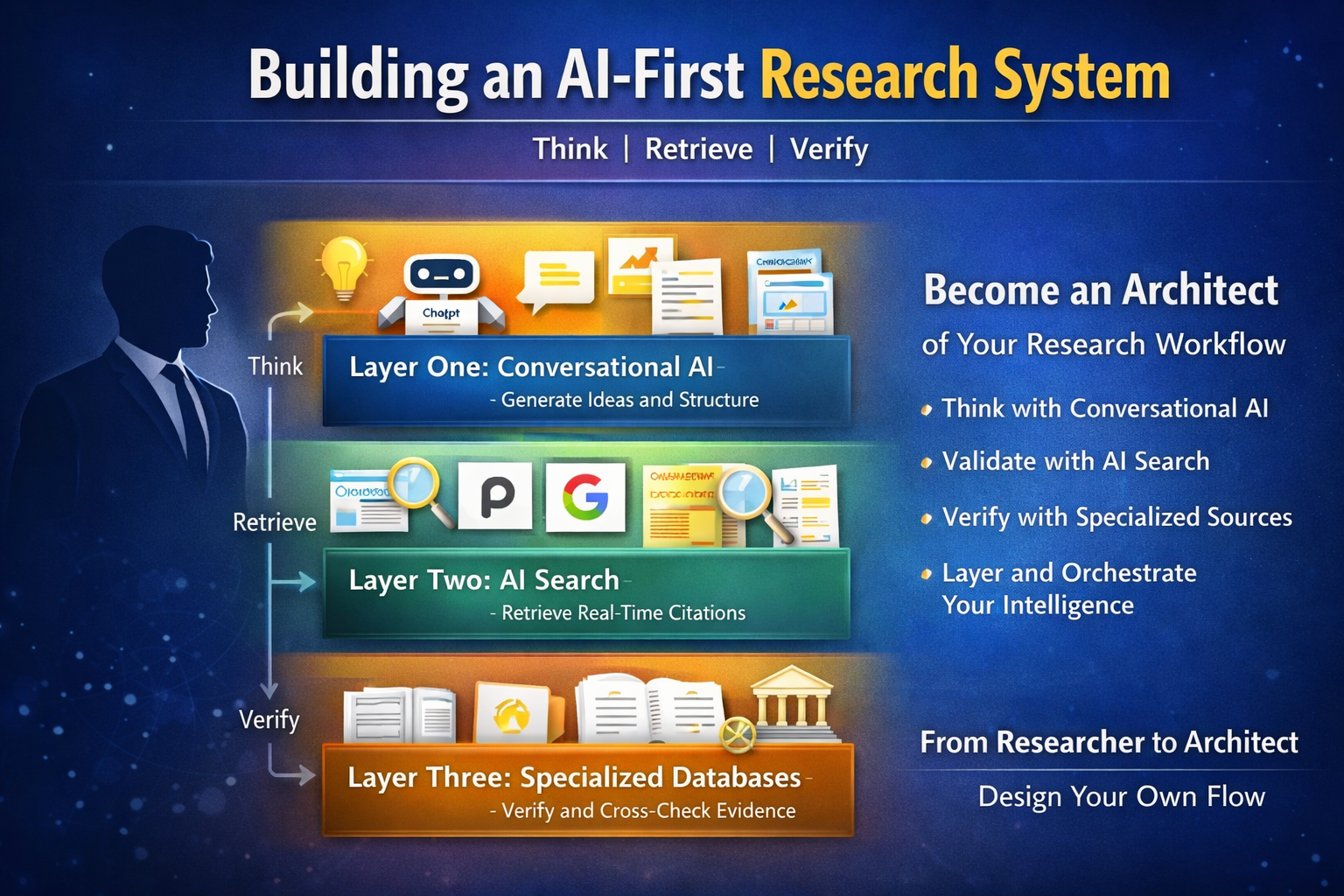
Research today has at least three distinct layers:
- Conversational AI for thinking and structuring.
- AI search engines for cited, real-time retrieval.
- Specialized databases for verification and depth.
Each layer has a different job.
When you mix them randomly, you create noise.
When you layer them intentionally, you create leverage.
Layer One: Conversational AI for Thinking
This is where most people start.
ChatGPT. Claude. Gemini. Pick your interface.
But here is the mistake I see constantly.
People treat conversational AI like an answer machine.
It is not an answer machine.
It is a thinking partner.
When I begin researching a topic, I do not ask for final answers. I ask for structure. I ask for frameworks. I ask for blind spots. I ask for counterarguments.
I want the model to pressure-test my thinking.
I use conversational AI to:
- Clarify the scope of a topic.
- Break a complex issue into dimensions.
- Surface assumptions I did not realize I was making.
- Generate competing angles.
- Stress-test a thesis.
- Identify terminology clusters.
- Outline possible structures.
This layer is generative.
It compresses exploration. It accelerates ideation. It makes the whiteboard phase dramatically faster.
But here is the key.
It is not your citation layer.
It is your thinking accelerator.
Why Conversational AI Should Not Be Your Final Authority
Conversational models synthesize patterns from training data. They are remarkably fluent. But fluency is not verification.
Benchmarks like TruthfulQA have shown that even advanced models can confidently produce incorrect or misleading answers, especially in nuanced or adversarial domains. The model may sound precise while being subtly wrong.
Not because it is malicious.
Because synthesis and verification are different tasks.
If you treat conversational AI as your final authority, you will eventually publish something inaccurate. It is not a matter of if. It is a matter of when.
This is not a flaw in the model.
It is a misunderstanding of the layer.
Thinking and verifying are different layers.
Which brings us to the second one.
Layer Two: AI Search Engines for Cited Facts
This is where retrieval enters the picture.
Tools like:
- Google AI Overview
- Perplexity
- ChatGPT browsing
- Bing Copilot
These systems are built on retrieval. They pull current indexed pages, attach citations, and allow you to inspect the sources.
After I use conversational AI to think through a topic, I move to AI search for validation.
Let’s say I am writing about AI citation overlap.
Conversational AI helps me frame the argument.
AI search engines help me answer:
- Where did the citation overlap numbers originate?
- Which study measured them?
- What was the methodology?
- Is the data recent?
- Has it changed over time?
This layer gives you anchors.
It gives you traceability.
It forces you to click through and inspect.
That is the difference between thinking and documenting.
Why AI Search Engines Still Lean on Rankings
Here is something important.
AI search engines do not operate in a vacuum.
Google AI Overview, for example, heavily overlaps with pages that already rank organically. BrightEdge research has shown that more than half of AI Overview citations now come from pages that rank in traditional organic results. At launch, that percentage was much lower. It has steadily increased.
That tells us something.
AI retrieval is reinforcing authority.
At the same time, it does not only cite top-ten results. Many citations still come from pages ranked beyond the first page. So ranking helps, but it is not the entire story.
Perplexity behaves similarly. It cross-references multiple sources, tends to favor consensus, and frequently pulls from high-authority domains.
So when you use AI search, you need to ask:
Is this source cited because it is correct?
Or because it is authoritative and well-structured?
Sometimes the answer is both.
Sometimes it is not.
This is where the third layer matters.
Layer Three: Specialized Databases for Verification
General search gives you breadth.
Specialized databases give you depth.
Depending on your field, that might mean:
- Academic journals
- Government reports
- Regulatory filings
- Industry research
- Financial statements
- Legal case repositories
This layer is slower.
It requires discipline.
It does not feel flashy.
But this is where you separate signal from narrative.
If a statistic is central to your thesis, you trace it back.
Who ran the study?
What was the sample size?
What industries were included?
What were the limitations?
Has newer data contradicted it?
This is where you stop sounding informed and start being informed.
Without this layer, your system is incomplete.
The Layered Workflow in Practice
Let me make this practical.
Here is what a clean AI-first research session looks like.
Step 1: Frame the Topic
Use conversational AI to outline the dimensions.
Ask for competing perspectives.
Clarify what you are actually trying to argue.
This is thinking.
Step 2: Validate with AI Search
Switch to AI search tools.
Confirm the key statistics.
Click the citations.
Cross-check multiple sources.
Document your trail.
This is anchoring.
Step 3: Verify Critical Claims
If the claim is central, go deeper.
Check the primary source.
Examine methodology.
Look for dissenting analysis.
This is auditing.
Now you have layered confidence.
Why Most People Never Build This
Because friction feels slow.
Conversational AI is addictive. It gives you polished language instantly. Verification requires effort.
But here is the paradox.
The more structured your workflow becomes, the faster your thinking gets.
You stop:
- Rewriting inaccurate drafts.
- Correcting factual mistakes.
- Losing source attribution.
- Publishing fragile arguments.
- Revising posts months later because numbers changed.
Speed without structure is chaos.
Structure compounds.
You Are Not Switching Tools. You Are Designing Flow
Most people are asking, “What is the best AI tool?”
That is the wrong question.
The better question is, “What layer am I operating in?”
Conversational AI for thinking.
AI search for citation.
Specialized databases for verification.
The power is not in the tool.
It is in the sequence.
From an AI visibility perspective, this matters even more.
AI engines reward content that is:
- Consistent across multiple sources
- Structurally clear
- Factually aligned
- Easy to parse
Your research flow directly shapes whether you can produce that consistently.
Turning This Into a Repeatable System
If you want this to become automatic, design rules.
For example:
- Never publish a statistic that has not passed through AI search validation.
- Never trust conversational AI on numbers without cross-checking.
- Separate synthesis from evidence in your writing.
- Keep a source log.
- Revisit key statistics every six to twelve months.
On a team, you can even assign layers.
One person lives in Layer One, shaping narrative.
Another lives in Layer Two, validating how search engines and AI systems treat the topic.
A third handles Layer Three when stakes are high.
That is architecture.
The Business Angle Emerging
Now zoom out.
AI search engines decide what to cite based on:
- Retrieval probability
- Authority signals
- Structured clarity
- Entity strength
- Index stability
If that is how citation works, then research is not only about consumption.
It is about representation.
Businesses need to ask:
How clearly are we represented in structured, machine-readable form?
Do we define our services explicitly?
Is our schema implemented correctly?
Are our entity names consistent?
Is our internal linking coherent?
Are our pages structured cleanly?
If your research system reinforces clarity, your publishing reinforces clarity.
And clarity increases retrievability.
The way you research affects the way you publish.
The way you publish affects how AI systems retrieve you.
That loop is tightening.
Designing Your Personal AI Research Architecture
Think of your workflow in three workspaces.
Thinking workspace.
Retrieval workspace.
Verification workspace.
Move between them intentionally.
Treat conversational AI like a whiteboard.
Treat AI search like a reference desk.
Treat specialized databases like an audit layer.
Once you see it that way, you stop chasing tools.
You start designing flow.
From Researcher to Architect
The biggest shift is mental.
You are not consuming AI outputs.
You are orchestrating intelligence.
Instead of asking, “Is this answer correct?” ask, “Which layer produced this answer?”
Instead of asking, “Which tool should I use?” ask, “What stage am I in?”
Instead of asking, “Can AI replace my research?” ask, “How do I structure AI so it strengthens my research?”
That posture changes everything.
Final Thought
AI tools are powerful.
But without structure, they amplify noise.
With structure, they amplify intelligence.
Building an AI-first research system is not about abandoning search engines.
It is about layering them properly.
Think with conversational AI.
Validate with AI search.
Verify with specialized sources.
Design your workflow consciously.
Because in the AI era, the advantage does not belong to the fastest user.
It belongs to the best architect.
At srchengine.com, we study how AI systems retrieve, cite, and rank information so you can design workflows that align with them.