Your brand can win every classic blue-link ranking and still disappear from the answers your customers actually read.
ChatGPT rewrites the web into one confident paragraph. Perplexity turns sources into a neat reading list. Google glues AI Overviews on top of search results and may cite sites users never scroll down to visit. Each one prefers and presents sources differently, so your hard-earned visibility is no longer guaranteed.
If you sell software, health services, financial advice, or B2B expertise, this is not theoretical. Prospects are already asking questions in these systems instead of “Googling it.” The real competition is now chatgpt vs perplexity vs Google, and you are invisible any time your brand is not chosen as a trusted source.
You cannot fix what you do not understand. To protect demand and discovery, you need to see how chatgpt vs perplexity vs Google select, rank, summarize, and attribute content, and how those choices create a new gap between being ranked and being mentioned. In this landscape, source preferences are your new visibility moat.
How it works: chatgpt vs perplexity vs Google
To understand source preferences, start with how each system actually builds an answer.
| System | Where it looks | How it picks sources | How it shows them |
|---|---|---|---|
| ChatGPT | Training data and live web (via Browse / GPT‑4o mini tools) | Chooses pages that match your prompt semantically, plus what the model “remembers” from training | Often no explicit links, or a short link list if browsing is used |
| Perplexity | Live web and its own index | Runs a search, ranks pages, then has the model read the top set before writing | Always shows inline citations and a visible source list with logos |
| Google Search index | Uses ranking signals plus quality systems like E‑E‑A‑T to choose “supporting” pages for AI Overviews [Google docs] | Shows a compact answer with a few linked cards, above classic results |
In plain terms: Google starts from search, then lets its AI summarize top results. Perplexity starts from AI, then pulls in fresh web pages to justify each line. ChatGPT starts from the model itself, then may call browsing tools to fill gaps. That is why any serious visibility audit now needs to frame the landscape as chatgpt vs perplexity vs Google, not just “search” in general.
For visibility, this means:
- Google rewards pages that already rank and meet quality thresholds, so SEO basics still matter.
- Perplexity rewards pages that are clear, recent, and easy to quote, so “answer‑
Why it matters
Ignoring source preferences is how you lose demand you already earned.
In a world of chatgpt vs perplexity vs Google, three things happen if you do nothing:
1. You get quoted without credit.
ChatGPT can internalize your content from training, then restate your frameworks with no link at all. Users remember the idea, not your brand. This is the “ranking vs mention” gap on steroids. Ranking vs Mention: The New Visibility Gap in AI Search
2. You lose the “shortlist” moment.
Perplexity often shows 5 to 10 clickable sources beside the answer. If your product, case study, or comparison page is not in that strip, you never make the consideration set, even if you rank in classic Google. For B2B and SaaS, that strip becomes the de facto vendor list.
3. You get displaced inside your own category.
Google AI Overviews can surface adjacent or competing sites as “supporting” pages, even when users searched your brand term. Over time, that conditions searchers to see you as one option among many, not the default. See how this plays out in Google AI Overviews vs Perplexity: What Businesses Need to Know.
The practical result of chatgpt vs perplexity vs Google source preferences: your analytics can look flat while your future pipeline quietly leaks to whoever these systems find easiest to quote and trust. To stay discoverable, you must design content that is rankable, quotable, and framed for how chatgpt vs perplexity vs Google decide which brands get named.
In practice
Picture a mid-market CRM vendor that “wins” traditional SEO for “CRM for real estate teams.”
In Google, they hold positions 1 to 3 with comparison pages and templates. Traffic looks healthy.
In Perplexity, the same query triggers an answer that cites a mix of G2, niche real estate blogs, and one big-brand CRM. The mid‑market vendor is missing. Their features are summarized generically from reviews and listicles, without their site in the visible source strip.
In ChatGPT, a buyer types, “Create a shortlist of CRMs for a 10‑person real estate team and explain the tradeoffs.” ChatGPT generates a structured comparison. The vendor’s positioning language appears almost verbatim, but no link or brand mention shows up at all. The idea travels. The brand does not.
Now the buyer searches the same phrase in Google. AI Overviews pull “supporting” pages from review sites and a Salesforce guide, not from the mid‑market vendor, even though their SEO pages still rank below.
This is chatgpt vs perplexity vs source preference in action: the systems agree on the job to be done, but disagree on which humans get named. For your own category, you should be asking how chatgpt vs perplexity vs Google would redraw the shortlist your sales team thinks it is competing on.
What to do: chatgpt vs perplexity vs source playbook
Use this week to tune content for how each system actually picks and shows sources.
1. Audit how you appear today
– Run 10 to 20 core queries in ChatGPT, Perplexity, and Google.
– Log: Are you cited, linked, or only paraphrased.
– Note which pages get surfaced and which competitors “own” the answer strip.
– Compare with classic rankings to see your ranking vs mention gap. Ranking vs Mention: The New Visibility Gap in AI Search
2. Create 1 “AI‑friendly” flagship page per topic
For each high‑value problem:
– Clear H1 that matches how a user would ask the question.
– Short, direct answer in the first 150 – 200 words.
– Bullets, definitions, and labeled sections that are easy to quote.
3. Format for Perplexity’s source strip
– Put a concise “Summary” or “Key takeaways” box at the top.
– Use descriptive subheads like “Pros,” “Cons,” “Best for,” and “Alternatives.”
– Add explicit comparison copy so Perplexity can justify naming you beside competitors. See broader context in Perplexity vs. ChatGPT vs. Google.
4. Tag and structure for Google AI Overviews
– Keep schema basics in place (Organization, Product, FAQ where appropriate).
– Make sure your best explainer pages actually target the questions AI Overviews show.
– Tighten quality signals: author bios, sources, and updated dates. Google AI Overviews vs Perplexity: What Businesses Need to Know
5. Defend attribution in ChatGPT
– Name your frameworks and methodologies clearly so they are easier to attribute.
Key takeaway
chatgpt vs perplexity vs Google: source preferences compared is really a question of who gets named at the moment of decision. When you think about future search strategy, treat every planning conversation as a chatgpt vs perplexity vs Google exercise, not a single-channel SEO checklist.
Google still rewards pages that rank and signal quality. Perplexity rewards pages it can cite cleanly in a compact, comparative strip. ChatGPT rewards ideas it has internalized, whether or not it links back.
Your job is not to “beat the algorithm.” It is to design content that can be ranked, quoted, and credited across all three.
Treat every important page as if an answer engine will skim only the top 200 words, pull two bullets, and choose three brands to display.
If your name, claim, and proof are not visible in that tiny slice, you are already losing the part of search that matters most.
—
Get the AI search briefing: one email a week, no fluff.
Keep reading

Google AI Overviews vs Perplexity: What Businesses Need to Know
If you’re taking AI search visibility seriously, you’ll hit a question fast: optimize for Google’s AI Overviews, Perplexity, or ChatGPT?…

Ranking vs Mention: The New Visibility Gap in AI Search
There’s a number many business owners check regularly and feel good about: their Google ranking. Position two for the main…
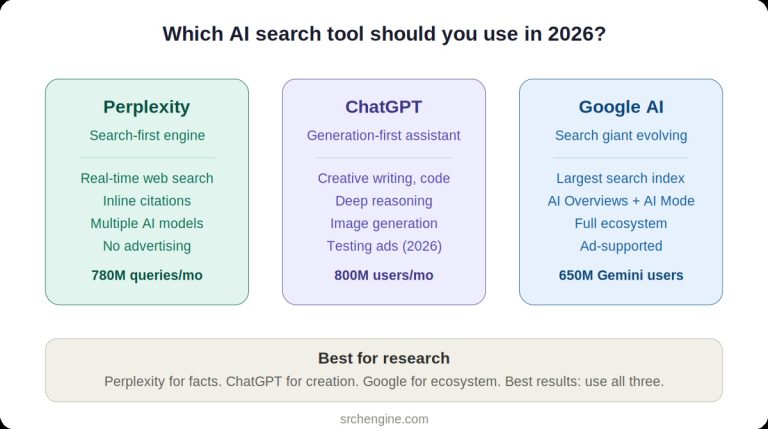
Perplexity vs. ChatGPT vs. Google
Which AI Search Tool Should You Use in 2026? The way we search has fundamentally changed. A year ago, most…