Which AI Search Tool Should You Use in 2026?
The way we search for information has fundamentally changed. A year ago, most people typed keywords into Google and scrolled through a page of blue links. Today, hundreds of millions of people are asking AI tools for direct answers instead – and the tools they’re choosing tell a very different story about where search is heading.
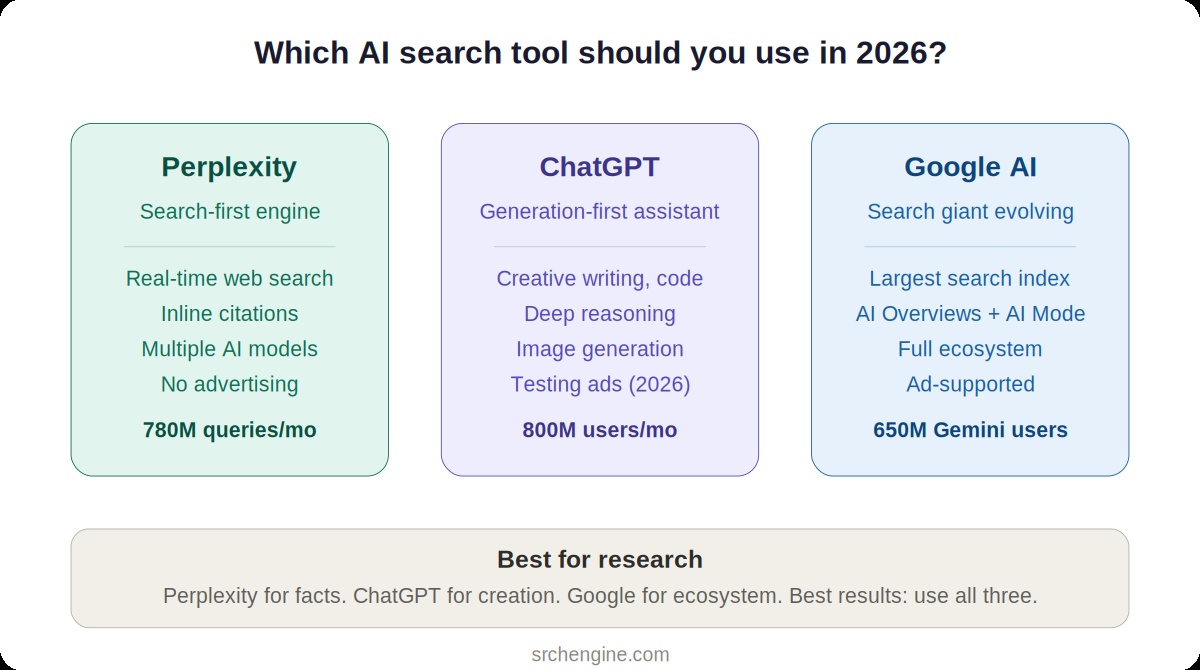
ChatGPT leads the pack with roughly 800 million monthly active users. Google Gemini sits at around 650 million. Perplexity, the scrappy newcomer, handles 780 million queries per month and just made a bold move: walking away from advertising entirely to focus purely on subscription revenue and unbiased answers.
Meanwhile, OpenAI went the other direction, testing ads inside ChatGPT for free-tier users starting in February 2026. Google continues deepening AI integration into its traditional search through AI Overviews and the newer AI Mode.
Three platforms. Three very different philosophies. So which one actually deserves your time?
We tested all three extensively across research tasks, fact-checking, creative work, and everyday questions to help you decide. Here’s what we found.
How Each Tool Actually Works
Before comparing results, it helps to understand what’s happening under the hood. These three tools take fundamentally different approaches to the same problem.
Perplexity: Search First, Then Synthesize
Perplexity is built from the ground up as an answer engine. When you ask a question, it searches the live web, reads multiple sources simultaneously, and synthesizes the information into a clear, conversational answer. Every claim comes with numbered citations you can click to verify.
This approach is called Retrieval-Augmented Generation (RAG). Perplexity retrieves information first, then generates a response grounded in what it found. The result feels like having a research librarian who reads everything and gives you a summary with footnotes.
Perplexity also lets you choose which underlying AI model powers your results, options include their own Sonar models, Claude, Gemini, and GPT-5, giving you flexibility depending on the task.
ChatGPT: Think First, Then Search (Maybe)
ChatGPT works differently. It generates responses primarily from its massive training data and the context of your conversation. It can search the web when needed, but browsing isn’t its default behavior, it decides based on the prompt whether real-time information is necessary.
This makes ChatGPT stronger at tasks that require reasoning, creativity, and extended conversation. It maintains context across long exchanges, generates original content, writes and debugs code, creates images, and can even execute multi-step workflows through features like Codex and Operator.
Think of ChatGPT as a versatile colleague who happens to know a lot and can look things up when needed, versus Perplexity, which always starts by looking things up.
Google AI: The Familiar Giant Evolving
Google’s AI integration comes in two flavors. AI Overviews appear automatically at the top of regular search results, providing AI-generated summaries for many queries. AI Mode goes further, offering a more conversational, ChatGPT-like experience within Google Search.
Google’s advantage is obvious: it sits on top of the world’s largest search index. When it generates AI answers, it draws from an unmatched breadth of indexed web pages. It also integrates seamlessly with the Google ecosystem – Maps, Scholar, Shopping, Workspace.
The tradeoff is that Google’s AI features still live within an advertising-supported platform. The answers you see may be influenced by commercial considerations in ways that Perplexity’s subscription-only model explicitly avoids.
Head-to-Head: What We Found
Accuracy and Citations
This is where Perplexity genuinely shines. Every response includes inline numbered citations linking to original sources. You can verify any claim in seconds. Research shows that Perplexity cites sources from Google’s top 10 rankings about 91% of the time, giving you well-established, authoritative sources.
ChatGPT can provide source links when web browsing is active, but citations aren’t as consistent or central to the experience. ChatGPT also overlaps with traditional Google top-10 results only about 14% of the time, meaning it surfaces different (sometimes fresher, sometimes less authoritative) sources.
Google AI Overviews pull almost exclusively from top-ranking pages – a 2026 study found that 99.5% of AI Overview sources come from pages already ranking in the top 10. This means Google’s AI answers are well-sourced but may not surface newer or less mainstream perspectives.
Winner: Perplexity for transparent, verifiable sourcing. Google for authoritative consensus. ChatGPT for surfacing diverse perspectives.
Speed and Efficiency
Perplexity returns fact-based answers almost instantly. For quick lookups – “What’s the current Fed rate?” or “Who won the Champions League?” – it’s the fastest path to an answer with a source attached.
ChatGPT is slightly slower on factual queries because it streams responses and may need to decide whether to search. But for longer, more complex outputs – essays, analysis, code, it’s faster and more fluid because it doesn’t need to re-check sources while writing.
Google AI Overviews appear near-instantly within search results, but the newer Deep Research feature (inside Gemini Advanced) takes 2–5 minutes as it autonomously browses 100+ web pages. The results are thorough but far from quick.
Winner: Perplexity for quick factual answers. ChatGPT for extended content generation. Google for queries where you also want traditional web results alongside the AI answer.
Real-Time Information
Perplexity searches the web by default on every query, making it reliably current. Whether it’s stock prices, breaking news, or just-published research, Perplexity pulls it in.
ChatGPT’s real-time capabilities depend on whether it decides to activate web browsing for your specific prompt. For many conversational queries, it relies on its training data, which has a knowledge cutoff. This means it can miss very recent developments unless you specifically prompt it to search.
Google has the deepest index and the freshest crawl data, but AI Overviews don’t always reflect the most recent information. Google’s traditional search results alongside the AI summary often provide better recency than the AI answer itself.
Winner: Perplexity for consistent real-time accuracy. Google for breadth of indexed information. ChatGPT trails on recency unless explicitly prompted to browse.
Creative and Analytical Tasks
This is ChatGPT’s home turf. Need to draft a blog post, brainstorm marketing copy, debug Python code, analyze a spreadsheet, create an image, or build a multi-step workflow? ChatGPT handles all of these and maintains context across a long, evolving conversation.
Perplexity can assist with writing and coding, but it’s optimized for retrieval, not generation. The outputs tend to be more concise and factual – excellent for research summaries, less ideal for creative writing or extended analysis.
Google’s AI features are still primarily search-augmented. Gemini can handle creative tasks when used directly, but within Google Search, the AI integration is focused on answering informational queries rather than generating original content.
Winner: ChatGPT by a wide margin for creative, analytical, and multi-step tasks.
Privacy and Trust
Perplexity’s decision to abandon advertising entirely is significant. The company’s position is that ads create a conflict of interest in an answer engine, once commercial content enters the results, users stop trusting the answers. By committing to subscriptions only, Perplexity is betting that users will pay for answers they can trust.
ChatGPT started testing sponsored results for free-tier users in early 2026. The ads appear below organic answers and are clearly labeled, but this introduces a commercial layer that didn’t exist before.
Google has always been advertising-supported, and its AI features operate within that framework. Google AI Overviews appear alongside ads, and the line between AI-generated content and commercially influenced results can sometimes blur.
Winner: Perplexity for ad-free, subscription-only trust. This matters most when you’re making decisions based on the answers – financial research, health questions, product comparisons.
Pricing Comparison
| Plan | Perplexity | ChatGPT | Google AI |
|---|---|---|---|
| Free | Yes – limited Pro Searches (5/day), basic model | Yes – GPT-4o with limits, web browsing | Yes – AI Overviews included in Google Search |
| Paid | Pro: $20/month (unlimited Pro Search, model selection, file upload) | Plus: $20/month (GPT-5, more usage, image gen, Codex) | Gemini Advanced: $20/month (via Google One AI Premium, Deep Research) |
| Business | Business: $40/user/month | Enterprise: custom pricing | Workspace AI: included in some Google Workspace plans |
All three offer capable free tiers, but the paid versions unlock meaningfully better experiences. The sweet spot depends on your primary use case.
So, Which One Should You Use?
The honest answer: it depends on what you’re doing. Here’s a quick decision framework.
Choose Perplexity If You…
- Need fast, factual answers with sources you can verify
- Do research-heavy work (academic, market research, journalism)
- Want an ad-free experience you can trust for unbiased information
- Prefer a search-engine replacement rather than a chatbot
Choose ChatGPT If You…
- Need a versatile digital assistant for writing, coding, and analysis
- Work on creative tasks — brainstorming, drafting, editing
- Want extended conversations that build on previous context
- Need multimodal capabilities (images, code execution, file analysis)
Choose Google AI If You…
- Want AI-enhanced answers without leaving your existing Google workflow
- Need access to Google’s ecosystem (Maps, Scholar, Shopping) alongside AI
- Prefer having traditional search results available alongside AI summaries
- Already pay for Google One or Workspace and want added AI features
The Power Move: Use Two or Three Together
Many people are finding that the best approach is combining tools. Use Perplexity for initial research and fact-finding with verified sources. Feed those findings into ChatGPT for deeper analysis, synthesis, and content creation. Keep Google for product research, local searches, and anything that benefits from its massive ecosystem.
This combined workflow takes the strengths of each platform and chains them together. It’s not about choosing one winner – it’s about knowing which tool to reach for at each stage of your workflow.
Where Is This All Heading?
The three-way split in AI search isn’t temporary. These platforms are diverging on purpose, each betting on a different vision of the future.
Perplexity is betting that people will pay for unbiased, ad-free answers. ChatGPT is betting that the most versatile assistant wins. Google is betting that its existing search dominance and ecosystem integration keeps users from leaving.
All three could be right – for different segments of users. The real disruption isn’t any single tool replacing Google. It’s the fact that for the first time in 25 years, people have genuine choices about how they find information. And that competition is making all three platforms better, faster.
The search landscape in 2026 is more exciting, more fragmented, and more useful than it’s ever been. The best move you can make right now is to spend a week using all three and discover which ones fit your specific workflow. You might be surprised by what sticks.
What’s your experience with these tools? Are you using one exclusively, or mixing and matching? We’d love to hear your take, drop us a note at editor@srchengine.com.