Your traffic chart still looks fine. Rankings are steady. Yet sales from search are slipping, and more new customers say, “I found you in Perplexity,” or “ChatGPT mentioned a competitor instead.”
Here is the disconnect: AI answers are becoming the first screen between your buyers and the open web. If your brand is not cited as a source inside those answers, you are invisible at the exact moment people are ready to act.
You can hold the number one blue link while a cheaper rival owns the AI recommendation that actually gets read. Ranking vs Mention: The New Visibility Gap in AI Search shows how often this happens already.
In this new environment, the citation economy why your site gets named inside AI answers matters more than where you rank. The citation economy why some pages attract links from AI and others never get touched is now a real revenue question. The citation economy why your brand is mentioned, or ignored, is becoming the core visibility problem to solve. If you are still optimizing only for blue links, you are missing how the citation economy why your competitors are suddenly everywhere in AI answers directly impacts who gets the next click.
How it works: the citation economy why AI links appear (or do not)
AI search tools work in three simple steps: read, reason, then recommend.
First, they crawl and index content, similar to classic search. Your pages get broken into chunks, tagged with topics, and stored in a vector index. If your technical setup is weak, your content may not even be in the pool. That is why infrastructure choices, like the stack in The WordPress Stack That Makes AI Search Engines Trust Your Site, still matter.
Second, they assemble an answer. When a user asks a question, the system pulls a small set of “candidate” pages, then the model writes a synthesized response. This is where the citation economy why some brands show up begins. The model looks for content that is clear, specific, and easy to quote, not just pages that are broadly relevant. The Anatomy of an AI Answer (Deconstructed) breaks down this step in detail.
Third, they attach links and attributions. Here the model chooses which sources to surface alongside the answer. It prefers pages that:
- Directly support each claim.
- Are formatted so snippets are easy to lift.
- Come from sites that look trustworthy and stable.
In other words, the citation economy why some pages repeatedly earn AI links is about citability more than raw ranking power. Content that was written for humans, then structured for machines, gets pulled again and again. If you want to influence these choices, focus on making each page the cleanest, safest “source block” a model can reuse. What Makes Content AI-Citable: A Practical Guide covers that shift step by step and helps you see the citation economy why small formatting changes can decide who gets surfaced.
Why it matters
Ignoring the citation economy is like defending your billboard while losing your sales floor.
When people ask AI tools “who should I use” or “what is the best option,” they see one synthesized answer plus a short list of sources. If your brand is not in that short list, you are not part of the consideration set, even if you rank first in classic search for the same query.
Several things start to break:
- Lead quality drops. You keep some informational traffic, but buyers who are ready to choose are funneled to whoever gets cited. Over time, this shifts revenue toward competitors who are “AI visible.”
- Brand authority erodes. If Perplexity or ChatGPT consistently mention three niche players in your space, users begin to treat those names as the experts. You become background, even if your content is stronger.
- Moats disappear faster. Smaller brands that master AI citability can leapfrog incumbents. Why AI Search Is Changing Business Visibility shows how quickly perception moves once AI answers standardize on a few sources.
- Measurement lags reality. Analytics still looks “fine” until the moment pipeline and direct-brand searches slip. You feel the damage months after AI systems have already rewritten the shortlist in your category.
Ignoring AI links today is like ignoring featured snippets when they first appeared. The businesses that learn how AI chooses sources, and adapt content the way What Makes Content AI-Citable: A Practical Guide describes, will own the recommendation layer everyone else depends on. That is the citation economy why the brands that adapt early will quietly compound advantage while others think rankings alone are enough.
In practice
Imagine a regional payroll SaaS that has owned “payroll software for contractors” in classic search for years. Their comparison guide ranks first in Google, but when buyers ask Perplexity “best payroll software for contractors,” the answer cites three competitors and a tax blog instead.
Why. Their guide is long, generic, and light on specific claims. It is hard to quote. A competitor’s page, by contrast, has a clean H2, “Best payroll software for contractors (2026),” a short criteria list, a clear pricing table, and a concise FAQ. Perplexity’s answer lifts that table, cites the competitor, and ignores the incumbent entirely.
The incumbent finally rewrites their page: tight definitions, explicit recommendations, bulletproof headings, and a short “How we evaluate contractor payroll tools” section. Within a few weeks, they start appearing as one of the cited sources in AI answers for that query and related ones.
Nothing huge changed in their classic rankings. What changed is their position in the citation economy why AI links are assigned. They moved from “background reading” to “quoted source,” which is where real buying decisions are now being shaped.
What to do in the citation economy: why this week matters
Use the next 7 days to shift from “ranking” to “being cited.”
1. Pick 1 – 2 priority questions
List the real questions buyers ask, like “best payroll software for contractors” or “how to choose a B2B SEO agency.”
Plug them into Google, Perplexity, and ChatGPT. Note:
– Which brands get cited
– Which specific URLs are linked
2. Map your current citability gap
For each question, compare the cited pages to your closest equivalent page. Ask:
– Do they make a clear recommendation
– Do they define terms and criteria
– Is there a concise summary or table AI could lift
Skim The Anatomy of an AI Answer (Deconstructed) to see how those elements show up inside answers.
3. Choose one “flagship” page to fix
Start with the page that should win the question that matters most. This is where you will test your new playbook for the citation economy why some brands keep getting linked.
4. Refactor it for AI reuse
In one working session:
– Add a blunt H1 and matching H2 that mirror the query
– Write a 3 – 5 bullet “at a glance” summary
– Add a criteria or steps section with numbered points
– Include one clear table that compares options or summarizes data
Use What Makes Content AI-Citable: A Practical Guide as a checklist.
5. Tighten your technical footing
Ensure the page loads fast, uses clean headings, and has proper schema where appropriate. If your stack is shaky, review The WordPress Stack That Makes AI Search Engines Trust Your Site and fix the obvious gaps. The citation economy why you are even in the candidate pool starts here.
6.
Key takeaway
Rankings measure where you sit on a page. Citations decide whether you enter the conversation at all.
In AI search, the citation economy why your brand is named inside answers is the real visibility metric. If an answer engine would not comfortably quote a block of your content, it will quietly route opportunity to someone else.
Build every important page so an AI system can point to it and think, “This is the safest, clearest source to reuse.” That is how you move from being scenery in the search results to being the recommendation that actually gets read.
Sources
For official guidance related to this article:
- Google Search Central — official guidance and updates
- OpenAI — official guidance and updates
—
Get the AI search briefing: one email a week, no fluff.
Keep reading

AI Search Trust Signals Explained Simply (No Tech Degree Required)
When an AI assistant recommends a business, it makes a trust decision. Of all the businesses it could mention, it…

Why Some Businesses Never Appear in AI Answers (Even Good Ones)
Here’s a puzzle. Two businesses, same city, same industry, similar quality, similar reviews. When someone asks an AI assistant for…
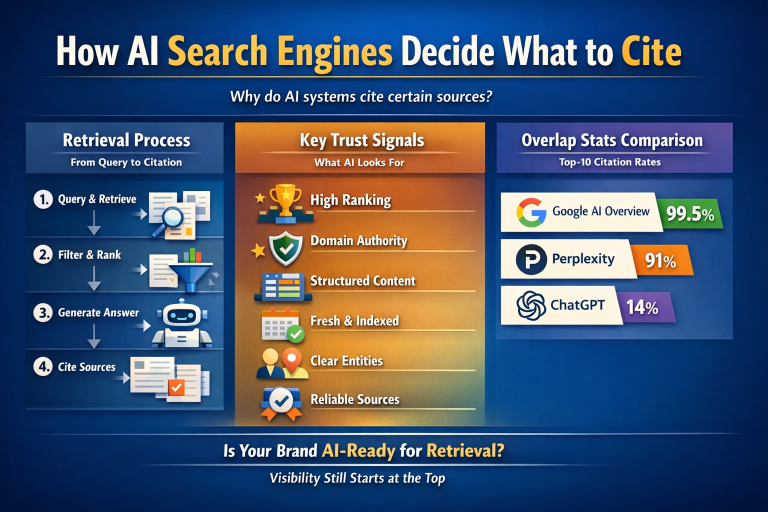
How AI Search Engines Decide What to Cite
A Deep Look at Retrieval, Trust Signals, and Why Visibility Still Starts at the Top If you ask ChatGPT a…