For most of my adult life, Google was the front door to the internet.
Every question. Every comparison. Every late night curiosity spiral that began with something harmless like “best espresso machine under $300” and somehow ended with Roman concrete.
Google felt permanent. Reliable. Almost invisible.
Then something shifted.
I noticed I was spending more time refining my queries than getting answers. I was opening five tabs, then ten. I was scanning SEO stuffed listicles written by people who had clearly never touched the product they were recommending. I was skimming ads disguised as advice.
And then I tried AI search seriously.
Not as a novelty. Not as a toy. But as a replacement.
This article is not hype. It is not anti Google rhetoric. It is a practical, tested, step by step guide on how to replace Google with AI search in your daily workflow.
If you run a business, lead a research team, write professionally, or simply value your time, this will change how you interact with information.
Let’s walk through it.
Why Replace Google with AI Search?
Before we talk tactics, we need to talk reality.
Google is built for indexing the web. AI search is built for synthesizing it.
That distinction matters.
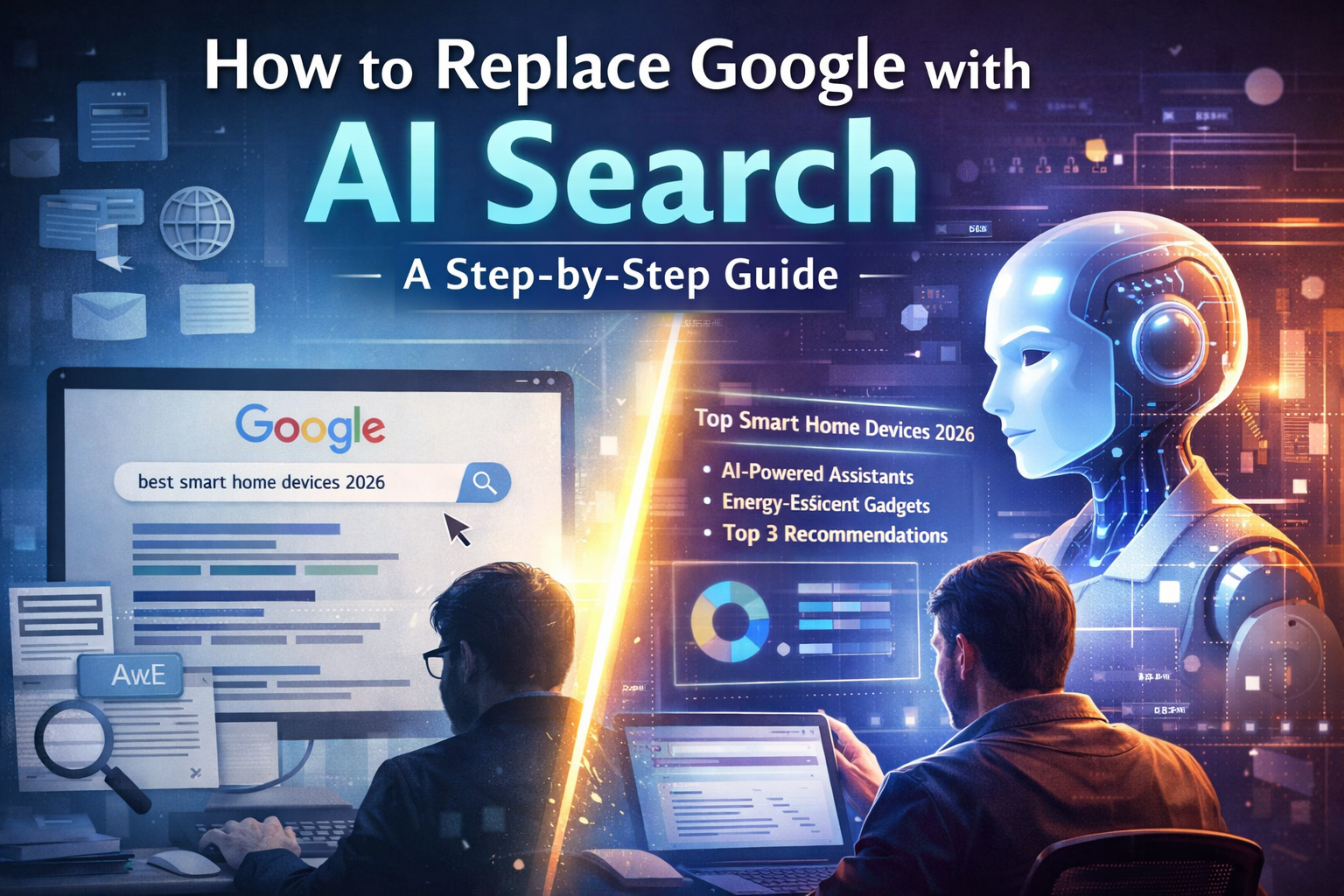
Traditional search engines return links. AI search engines return answers.
When you search “How to start a newsletter,” Google gives you a page of ranked results. You click. You scan. You compare. You decide which one feels trustworthy.
When you use AI search, you ask the same question and receive a structured response that summarizes multiple sources, explains tradeoffs, and adapts to follow up questions.
The difference is not speed alone. It is cognitive load.
Google forces you to assemble the puzzle.
AI search hands you a draft of the puzzle already built.
That is the fundamental shift.
Step 1: Change the Mental Model
The first step in replacing Google with AI search is psychological.
You must stop thinking in keywords and start thinking in conversations.
Google rewards keyword precision.
AI search rewards clarity of intent.
Instead of typing:
“best CRM small business 2026 pricing comparison”
You can say:
“I run a small consulting firm with five employees. We need a CRM that integrates with email, tracks deal stages, and costs less than $100 per user per month. Compare three good options.”
That single shift unlocks the power of AI search.
You are no longer gaming an algorithm.
You are briefing an assistant.
Step 2: Choose the Right AI Search Tools
Not all AI search platforms are created equal.
Here are the major categories you should understand:
1. Conversational AI Platforms
Examples include:
- ChatGPT
- Claude
- Gemini
These are powerful for structured answers, deep explanations, and multi step reasoning.
2. AI Powered Search Engines
Examples include:
- Perplexity AI
- You.com
- Microsoft Copilot
These combine real time web access with AI summarization. They are excellent for current events, research, and fact checking.
3. Vertical AI Search Tools
Some platforms specialize in:
- Academic research
- Legal search
- Medical search
- Code search
For example, developers might use GitHub Copilot or AI coding assistants instead of Googling Stack Overflow.
Your replacement strategy will likely include a combination.
Step 3: Replace Specific Google Use Cases
You do not replace Google all at once. You replace use case by use case.
Let’s break this down.
Use Case 1: Quick Factual Questions
Old way:
You search “capital of Portugal.”
New way:
Ask AI directly.
The answer is immediate, often with context and history.
Use Case 2: Product Research
Old way:
Search.
Open five affiliate sites.
Skim for bias.
New way:
Ask:
“I am choosing between a mid range espresso machine for home use. I drink two shots per day. I care about durability more than fancy features. What should I consider?”
Then follow up:
“Which of these models have strong user feedback on long term reliability?”
You move from searcher to decision maker in one thread.
Use Case 3: Learning a New Skill
Old way:
YouTube search.
Blog posts.
Forum threads.
New way:
“Teach me the basics of Python as if I have never coded before. Give me exercises after each section.”
AI becomes a structured tutor.
Use Case 4: Business Research
Old way:
Industry reports.
SEO blog posts.
LinkedIn digging.
New way:
“Summarize the current trends in AI search monetization models. Include venture funding data and major players.”
Then:
“Create a competitive landscape table.”
You are not just retrieving information. You are transforming it.
Step 4: Develop Prompt Discipline
Replacing Google with AI search requires learning how to ask better questions.
Here is a simple framework:
1. Define Context
Who are you?
What are you trying to do?
2. Define Constraints
Budget.
Timeline.
Skill level.
Location.
3. Define Output Format
Table.
Bullet list.
Executive summary.
Step by step plan.
For example:
“I am the editor of an AI search publication. I want a 1,500 word analysis comparing AI search engines in terms of speed, citation quality, and monetization models. Present it in structured sections.”
That clarity produces better results than any keyword string ever could.
Step 5: Fact Check Strategically
One concern many people raise is accuracy.
This is valid.
AI search should not eliminate verification. It should streamline it.
Best practice:
- Ask AI for the answer.
- Ask AI for sources.
- Cross verify key claims in a trusted database or official site.
The workflow becomes:
Synthesis first. Verification second.
Instead of manually aggregating ten sources, you let AI aggregate them and you validate selectively.
This alone can cut research time in half.
Step 6: Integrate AI Search Into Daily Workflows
Replacing Google means embedding AI into your habits.
Here is how to do that.
Browser Setup
- Set your default search engine to an AI search platform.
- Pin your preferred conversational AI tool.
Research Workflow
Before opening a new tab, ask:
“Can AI answer this?”
Force yourself to try AI first for 30 days.
Team Adoption
If you manage a team, create guidelines:
- Use AI search for first draft research.
- Verify before publication.
- Cite properly.
In editorial environments like ours at srchengine.com, AI search becomes the first layer of intelligence, not the final authority.
Step 7: Understand Where Google Still Wins
This is not a zero sum game.
Google remains powerful for:
- Navigational searches
- Finding specific websites
- Local business listings
- Real time maps and directions
If I need the login page for a tool, Google is efficient.
If I need a structured explanation of a complex concept, AI wins.
The smart replacement strategy is selective, not ideological.
The SEO Perspective: Why This Shift Matters
If you run a website, this transformation affects you deeply.
AI search changes:
- Click behavior
- Content discovery
- Attribution models
Users increasingly get answers without clicking through.
That means content must:
- Be structured for AI extraction.
- Be authoritative and data driven.
- Provide unique insight beyond generic summaries.
This is why AI optimized content is becoming essential.
Instead of writing for keywords alone, you write for:
- Semantic clarity
- Direct answer quality
- Context richness
The future of SEO is not search engine optimization.
It is answer engine optimization.
Advanced Strategy: Building a Personal AI Research System
If you want to go beyond casual usage, build a layered system.
Layer 1: Conversational AI
For thinking and brainstorming.
Layer 2: AI Search Engine
For cited, current information.
Layer 3: Specialized Databases
For official data.
For example:
When researching AI search monetization models:
- Ask AI for overview.
- Use AI search engine for citations.
- Verify funding rounds through Crunchbase or official filings.
You reduce friction without sacrificing rigor.
Common Mistakes When Switching to AI Search
- Asking vague questions.
- Accepting the first answer without refinement.
- Treating AI like Google with different syntax.
- Forgetting to verify critical data.
- Ignoring follow up questions.
The magic of AI search lies in iteration.
The first answer is rarely the final one.
A Real World Example
Recently, I needed to evaluate whether to launch a subscription model for an AI focused publication.
Old workflow:
- Google search industry reports.
- Download whitepapers.
- Scan Medium articles.
- Piece together numbers manually.
New workflow:
I asked AI:
“Analyze subscription trends in niche technology media over the past five years. Include pricing models and churn patterns.”
Then:
“Create a pros and cons list for launching a $19 per month subscription for a publication focused on AI search.”
Within minutes, I had a structured starting point.
I verified the data.
I refined assumptions.
I made a decision faster.
The difference was not just speed.
It was clarity.
The Psychological Shift
Replacing Google with AI search feels strange at first.
There is comfort in blue links.
There is habit in scrolling.
But once you experience a fully contextual answer that understands your situation, it is difficult to go back.
It feels like moving from a library card catalog to a research assistant sitting across from you.
You still think.
You still decide.
But you think at a higher level.
The Future of Search
AI search is not a feature.
It is a structural change.
Search engines historically ranked pages.
AI systems interpret and generate meaning.
As models improve:
- Context retention will increase.
- Personalization will deepen.
- Integration with work tools will expand.
We are moving from search queries to research sessions.
And that changes everything.
Final Thoughts: Should You Fully Replace Google?
Here is the honest answer.
You do not need to eliminate Google.
You need to demote it.
Let AI handle:
- Explanations
- Comparisons
- Brainstorming
- Research synthesis
Let Google handle:
- Direct navigation
- Maps
- Specific website retrieval
Test it for 30 days.
Track your time.
Track your friction.
Track your clarity.
Most people discover that AI search becomes the primary interface for information.
Google becomes secondary.
That is not rebellion.
That is evolution.
Next Steps
- Choose one AI search tool today.
- Use it instead of Google for one week.
- Refine your prompting.
- Document the difference.
- Scale what works.
Information is abundant.
Clarity is rare.
AI search, when used properly, delivers clarity.
And that is worth the switch.